qu'est-ce que tu cherches
?

Comment les objectifs des caméras ADAS améliorent la sécurité routière
May 29, 2026Les systèmes avancés d'aide à la conduite, communément appelés ADAS, jouent un rôle de plus en plus important dans la sécurité des véhicules modernes. Ces systèmes aident les conducteurs à détecter les conditions de la route, à surveiller les objets environnants, à identifier les risques potentiels et à améliorer leur vigilance au volant.
Dans de nombreuses applications ADAS, les caméras jouent un rôle essentiel dans la collecte d'informations visuelles. Cependant, la qualité d'image d'un système de caméra ne dépend pas uniquement du capteur d'image. L'objectif de la caméra est le premier composant optique qui capte la lumière et forme l'image avant qu'elle n'atteigne le capteur.
Un approprié Objectif de caméra ADAS Elle peut contribuer à améliorer le champ de vision, la netteté de l'image, la réduction de la distorsion, les performances en basse lumière et la stabilité à long terme. Ces facteurs sont étroitement liés à la capacité d'un module caméra à assurer les fonctions de sécurité routière.
L'objectif d'une caméra ADAS est un objectif optique utilisé dans les modules de caméras automobiles pour les systèmes avancés d'aide à la conduite. Il permet de capturer les informations visuelles autour du véhicule et de transmettre l'image au capteur pour traitement ultérieur par le système.
Les objectifs de caméra ADAS peuvent être utilisés dans différentes applications de caméras automobiles, notamment :
Les différentes applications ADAS requièrent des conceptions d'objectifs différentes. Par exemple, une caméra frontale peut nécessiter une netteté à longue distance et une faible distorsion, tandis qu'une caméra à vision panoramique requiert généralement un champ de vision plus large et une qualité d'image stable sur les bords.
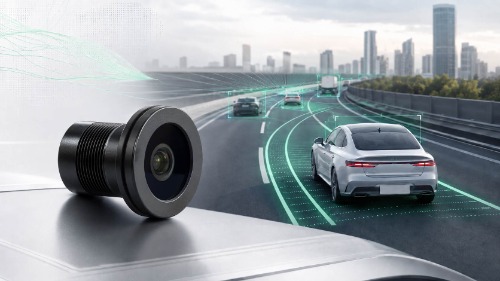
Les systèmes ADAS nécessitent une image nette et stable pour reconnaître l'état de la route, les véhicules, les piétons, le marquage au sol, la signalisation et les obstacles. Si l'objectif ne fournit pas des performances optiques adéquates, le capteur risque de ne pas recevoir d'informations d'image précises.
L'objectif de l'appareil photo influe sur plusieurs facteurs clés de l'imagerie :
Un objectif de caméra automobile bien conçu aide le module de caméra à capturer des données d'image plus fiables, ce qui peut contribuer à des performances ADAS plus sûres et plus stables.
Le champ de vision est un facteur primordial dans le choix de l'objectif d'une caméra pour système ADAS. Un champ de vision plus large permet à la caméra de capturer davantage d'informations sur l'environnement, ce qui est utile pour des applications telles que les caméras de recul, les systèmes de vision panoramique, l'aide au stationnement et la surveillance latérale.
Par exemple, l'objectif d'une caméra de recul doit couvrir la zone située derrière le véhicule pour permettre au conducteur de repérer les obstacles lors des manœuvres. L'objectif d'une caméra à vision panoramique doit capturer une large zone autour du véhicule pour offrir une vue à 360 degrés.
Cependant, un champ de vision plus large n'est pas toujours un avantage en soi. Il convient de trouver un équilibre entre la maîtrise de la distorsion, la netteté de l'image, la taille du capteur et les exigences de l'application. Pour les modules de caméra ADAS, le choix de l'objectif doit prendre en compte à la fois les performances optiques et les besoins d'imagerie du système.
La maîtrise de la distorsion est particulièrement importante pour les objectifs des caméras ADAS. Dans les applications automobiles, la distorsion de l'image peut affecter l'apparence des objets, des lignes de la route et de l'environnement.
Pour des applications telles que la reconnaissance de voies, la détection d'objets, l'aide au stationnement et les systèmes de vision panoramique, une faible distorsion contribue à préserver une image plus précise. Ceci est particulièrement important en bordure d'image, où les objectifs grand angle peuvent engendrer une distorsion plus visible.
A objectif de caméra ADAS à faible distorsion Cela permet d'améliorer la cohérence des images et de rendre la scène capturée plus fidèle à l'environnement réel. C'est particulièrement utile pour les systèmes qui reposent sur la reconnaissance d'images et l'analyse visuelle.
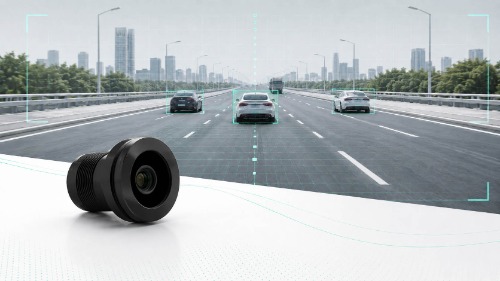
De nombreux modules de caméras automobiles utilisent désormais des capteurs de 2 MP, 5 MP, 8 MP, voire de résolution supérieure. Cependant, un capteur haute résolution nécessite également un objectif aux performances optiques équivalentes.
Si la résolution de l'objectif est insuffisante, le capteur risque de ne pas exploiter pleinement son potentiel en matière de qualité d'image. Il peut en résulter une netteté d'image réduite, une moindre reconnaissance des détails et des performances de détection d'objets moins performantes.
Lors du choix d'un objectif pour une caméra ADAS, il est essentiel de vérifier sa compatibilité avec la taille du capteur, la résolution, le cercle d'image et le champ de vision requis. Un objectif adapté permet au module caméra de capturer des détails plus nets, ce qui améliore la reconnaissance des véhicules, des piétons, du marquage routier et autres objets.
Les véhicules évoluent dans des environnements très variés. Les caméras des systèmes ADAS peuvent être amenées à fonctionner de jour, de nuit, par temps de pluie, dans des tunnels, en faible luminosité et en contre-jour. Ces conditions changeantes imposent des exigences accrues aux performances optiques des objectifs des caméras automobiles.
Selon les exigences du projet, la conception des lentilles peut devoir prendre en compte :
La stabilité des performances d'imagerie permet au module caméra de fournir des informations visuelles plus cohérentes dans différentes conditions de conduite.
Les caméras automobiles sont soumises à des exigences de fiabilité plus élevées que de nombreuses applications électroniques grand public. Les objectifs doivent notamment résister aux variations de température, aux vibrations, à l'humidité, à la poussière, à l'eau et à un fonctionnement prolongé.
Pour les projets automobiles, un contrôle qualité rigoureux et une production constante sont essentiels. Une lentille utilisée dans un module de caméra automobile doit non seulement répondre aux exigences optiques, mais aussi permettre un assemblage fiable et une production en série.
Wintop Optics possède les certifications TS16949 et ISO, ainsi qu'une expérience dans projets de lentilles automobilesCes capacités contribuent à assurer un contrôle qualité stable, une évaluation par projet et une coopération à long terme pour les applications de modules de caméras automobiles.
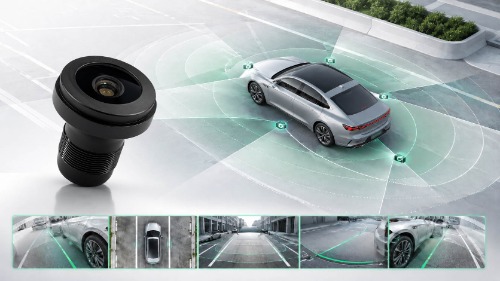
Les différentes applications de caméras ADAS nécessitent des conceptions optiques et structurelles différentes. Voici quelques exemples courants :
| Application ADAS | Exigences typiques en matière d'objectifs |
|---|---|
| Caméra frontale | Clarté à longue distance, faible distorsion, imagerie stable |
| caméra de recul | Champ de vision large, conception étanche, image nette |
| Caméra à vision panoramique | Ultra grand angle, contrôle de la distorsion, netteté des bords |
| Système de surveillance du conducteur | Imagerie de proximité, prise en charge infrarouge, reconnaissance faciale |
| Système de surveillance des occupants | Large couverture de la cabine, performances en faible luminosité |
| Système de surveillance par caméra | Qualité d'image stable, fiabilité de niveau automobile |
| Aide au stationnement | Grand angle de vision, structure compacte, stabilité environnementale |
Pour chaque application, l'objectif doit être sélectionné en fonction du capteur, du champ de vision, de la résolution, de la distance de travail, de la structure et des exigences environnementales.
Pour choisir un objectif adapté à une caméra ADAS, les clients doivent généralement évaluer à la fois les exigences optiques et la structure mécanique. Fournir des informations complètes sur le projet permet aux ingénieurs de recommander une solution d'objectif plus appropriée.
Les informations clés comprennent généralement :
Wintop Optics propose différentes options de structure de lentille, notamment les solutions M7, M8, M9, M10, M12 et AA. La structure la plus adaptée dépend de la conception du module caméra, des exigences optiques, de la méthode d'assemblage et de l'environnement d'utilisation.
Wintop Optics fournit des solutions de lentilles optiques pour les applications de modules de caméras automobiles, notamment les caméras de recul, les caméras de vision panoramique, les CMS, DMS, OMS et autres systèmes liés aux ADAS.
Certifiée TS16949 et ISO, et forte d'une expérience dans le domaine des optiques automobiles, Wintop Optics accompagne ses clients en leur garantissant un contrôle qualité rigoureux, une évaluation précise de la conception optique et une sélection d'objectifs adaptée à chaque projet. Nous proposons différentes structures d'objectifs, notamment M7, M8, M9, M10, M12 et AA, en fonction de la conception du module caméra et des exigences de l'application.
Si vous développez un module caméra pour systèmes avancés d'aide à la conduite (ADAS), veuillez nous communiquer le modèle de votre capteur, le champ de vision, la résolution, la structure et les exigences de votre application. Notre équipe pourra vous recommander une solution d'objectif adaptée à votre véhicule.
Tél. / WhatsApp : +86 15302689906
E-mail: yorty@yuntal.com
Pour recommander un objectif de caméra ADAS adapté, nous avons généralement besoin du modèle de capteur, de sa taille, de sa résolution, du champ de vision requis, de la distance de mise au point, de la structure de l'objectif, du scénario d'application et de l'environnement d'utilisation. Si le projet présente des exigences en matière d'étanchéité, d'infrarouge, de température ou de vibrations, ces détails doivent également être fournis.
Pas toujours. Les applications de vision arrière, panoramique, avant, DMS, OMS et CMS peuvent nécessiter des champs de vision, des corrections de distorsion, des distances de travail, des structures et des performances environnementales différents. Le choix de l'objectif doit se faire en fonction de la conception du module caméra et des exigences de l'application.
La maîtrise de la distorsion est essentielle car les systèmes ADAS s'appuient sur les informations d'image pour la détection d'objets, la reconnaissance des voies et l'analyse de l'environnement. Un objectif à faible distorsion contribue à préserver une image plus précise, notamment en bordure.
Oui. Le choix ou la personnalisation de l'objectif peut être évalué en fonction du modèle de capteur, de sa taille, du champ de vision, de la résolution, de la structure mécanique et du scénario d'utilisation. Pour les projets de caméras automobiles, les performances optiques et la fiabilité mécanique doivent être considérées conjointement.
Les différents modules de caméras automobiles peuvent utiliser différentes structures de lentilles, telles que les lentilles M7, M8, M9, M10, M12 et AA. La structure appropriée dépend de la taille du module, des exigences optiques, de la méthode d'assemblage et de l'environnement d'utilisation.
Cela dépend de l'application. Les caméras automobiles extérieures, telles que les caméras de recul, de vision panoramique et de stationnement, doivent généralement répondre aux exigences d'étanchéité, de résistance à la poussière, aux températures extrêmes et aux vibrations. Les caméras intérieures, comme les systèmes de surveillance des angles morts (DMS) ou les systèmes de surveillance des angles morts (OMS), peuvent privilégier l'imagerie à courte distance, les performances infrarouges et la vision en faible luminosité.
Vous recherchez une solution d'objectif de caméra ADAS adaptée ?
Chaque projet de caméra ADAS présente des exigences optiques et structurelles différentes. Qu'il s'agisse de vision avant, arrière, panoramique, de systèmes de surveillance des feux de circulation (DMS), de systèmes de surveillance des feux de circulation (OMS), de systèmes de surveillance des angles morts (CMS) ou d'aide au stationnement, le choix de l'objectif doit être basé sur la conception du module de caméra.
Wintop Optics propose des solutions d'objectifs pour caméras automobiles avec différentes structures, notamment les options d'objectifs M7, M8, M9, M10, M12 et AA.
Partagez avec nous le modèle de votre capteur, son champ de vision, sa résolution, sa structure et les exigences de votre application. Notre équipe vous aidera à choisir la solution optique la plus adaptée à votre projet.
Tél. / WhatsApp : +86 15302689906
Courriel : yorty@yuntal.com
 Inscrivez-vous à nos newsletters
Tél : Overseas contact Lina : 86 153-0268-9906
Overseas emial : yorty@yuntal.com
WhatsApp : +86 153-0268-9906
E1108, Jinbolong Building, Longhua, Shenzhen,Guangdong, China


Friendly Links :
whatsappdroits d'auteur © 2026 WINTOP OPTICS CO., LTD.. Tous droits réservés .粤ICP备2025439823号-1
 IPv6 network supported.